Welcome aboard!
Tap on the icons to find out fascinating facts about the Harbour and Fergus and his friends.
Welcome aboard!
Tap on the icons to find out fascinating facts about the Harbour and Fergus and his friends.











George
Description – Steel-hulled, commercial, fire-fighting tug
Role – Fire-fighting, salvage and emergency response services
Speed – 10 knots
Crew – 4 – Master, engineer and two crew
Hose capacity – 10,000 litres a minute in a 90 metre jet
Angus
Description – Short haul, single hull, twin engine ferry
Role – Only services the safer Inner Harbour
Speed – 12 knots
Crew – Master, engineer and general-purpose hand
Capacity – 400 passengers
Pyrmont Bridge
Pyrmont Bridge is one of the world’s oldest surviving electrically operated swing span bridges – it opened in 1902 and initially carried cars. This was where Boris was marooned in ‘Fergus Joins the Search’.
Admiralty House
This is Admiralty House, which is the official residence of the Governor General, who is the King’s representative in Australia.
Harbour Bridge
The Harbour Bridge is the entrance to the Inner Harbour. Manly ferries don’t usually go up the Inner Harbour.
The Harbour Bridge contains approximately 6,000 rivets which hold together 52,800 tonnes of steel.
It was opened on 19 March 1932. At 48.8 metres, it is the tallest and widest steel arch bridge in the world.
Opera House
The Sydney Opera House is one of the most famous buildings in the world and sits beside Sydney Harbour. It is known for its white, sail-shaped roofs that look like shells or waves. The building was designed by a Danish architect named Jørn Utzon and opened in 1973. Inside the Opera House are theatres and concert halls where people watch music, dance, plays, and performances. It is home to the Sydney Symphony Orchestra and Opera Australia. Many visitors come to take photos, watch shows, and enjoy views of the Harbour Bridge nearby.
Circular Quay
This is where the ferries come to take passengers to the city. Circular Quay is the hub for Sydney’s ferry services with over 100 departures every day.
Fort Denison
Fort Denison is a small island fort in the middle of Sydney Harbour, close to the Sydney Opera House. Long ago, it was called Pinchgut Island. The fort was built in the 1800s to help protect Sydney from enemy ships. Stone walls and cannons were added so soldiers could watch the harbour and keep people safe. Fort Denison was also used as a place to punish prisoners in early colonial times. Today, it is a historic site that people can visit by ferry. Visitors can explore the old buildings, learn about history, and enjoy beautiful harbour views.
Garden Island
Garden Island is the home of the Royal Australian Navy’s Fleet Base East. It was established in 1788 as a place to grow vegetables for the First Fleet. Ark, the aircraft carrier, would have docked here.
Wooloomooloo
When built, Wooloomooloo was the largest wooden structure in the world. It is now home to apartments, great restaurants and a hotel.
Taronga Zoo
Taronga Zoo is a famous zoo in Sydney, Australia, located on a hill overlooking Sydney Harbour. It is home to more than 4,000 animals from Australia and around the world with 34o different species.
All but 8 of the 48 shark bites recorded in Sydney Harbour since 1807 were inflicted by bull sharks. Bull sharks tend to like murky waters, hunting at dawn and dusk and in high-transit areas. Sydney has a number of beaches where nets are installed, to provide a safe area to swim – free of the danger of shark bites.
Cruising Yacht Club of Australia
This is the Cruising Yacht Club of Australia. It is where the boats which take part in the race in ‘Fergus Goes Bang’ start from in the Boxing Day race.
Darling Point
In March 1995, Mary Meagher, was paddling in the Harbour just off Darling Point on her surf ski when a shark swam underneath her, bit a chunk out of her surf ski and flipped her into the water. She got back onto her ski and waited for 10 minutes – petrified – until a ferry came and rescued her. This is the origin of the story in ‘Fergus to the Rescue’.
Double Bay
Double Bay is one of the stops on Fergus’ usual run to Rose Bay and Watson’s Bay.
Bradley’s Head
This is Bradley’s Head. The foremast of the cruiser HMAS Sydney, which took part in the first ship against ship battle in World War 1, is mounted here as a memorial to that battle.
Fergus Ferry
Description – Short haul, single hull, twin engine ferry
Role – Services the Outer Harbour and destinations to Watsons Bay. Doesn’t usually cross the entrance to the Harbour where there can be big swells and rough waves.
Speed – 12 knots
Crew – Master, engineer and general-purpose hand
Capacity – 400 passengers
Kate
Description – Offshore police patrol vessel
Role – Law enforcement, search and rescue
Speed – 26 knots
Crew – Master and two deck hands
Hydro
Description – High-speed, planning hydrofoil
Role – High speed service on the Manly run
Speed – 35 knots
Crew – 4
Capacity – 140 passengers
Lady Jane
Description – Double-ended, single hull ferry
Role – Used to operate the Circular Quay to Manly run but is now a restaurant
Speed – 17 knots (and there’s still no ferry that’s faster than that)
Crew – Sufficient
Capacity – 1,781 passengers
‘C’ Seaplane
Description – Single engine float plane, capable of landing on any suitable waterway
Role – Scenic trips above the Harbour and short trips along the coastline
Speed – 160 knots
Crew – 1 pilot
Capacity – 12 passengers
Rose Bay
Rose Bay was Sydney’s first international airport from 1938. It was used when passengers flew the world in flying boats. This is where ‘C’, the seaplane operates from.
Boris and Horace
Description – Double ended single hull ferry. Manly ferries don’t need to turn around because they have a bridge at the front and the back
Role – Operates the Circular Quay to Manly service. Crosses the entrance to the Harbour in all but the roughest seas.
Speed – 12.5 knots
Crew – Master, engineer and 4 general purpose hands
Capacity – 1,100 passengers
Jimmy and Jock
Description – Steel-hulled, twin screw, harbour tug
Role – Assisting ships up to 280 metres to dock
Speed – 12 knots
Crew – Master, engineer and two bollard hands
Capacity – 41 tonnes bollard pull
Jimmy and Jock
Description – Steel-hulled, twin screw, harbour tug
Role – Assisting ships up to 280 metres to dock
Speed – 12 knots
Crew – Master, engineer and two bollard hands
Capacity – 41 tonnes bollard pull
South Head
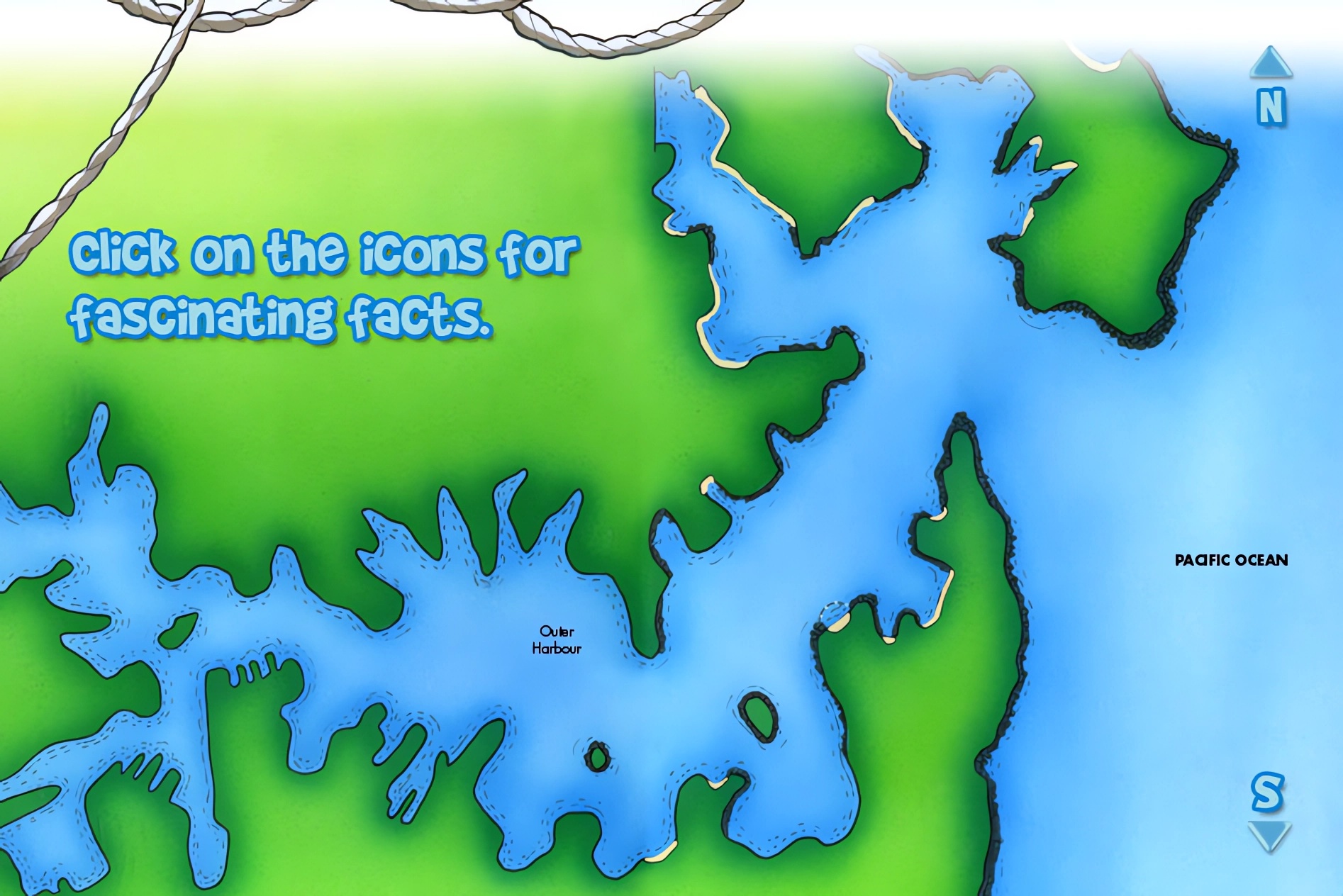
The red and white lighthouse marks the entrance to the Harbour
Sow and Pigs
The Sow and Pigs reef is a partially submerged rocky shoal in the middle of the Harbour. It is a hazard to ships which is why there are channel markers on it. This is where Boris crashed on the day when fog blanketed the Harbour.
Here’s a channel marker in the harbour. These look like wedding cakes. They tell the ships which way to go. At night, the lights that’s inside them light up green or red. When leaving the harbour, you keep the green ones on your left, the red ones on your right. Don’t get that wrong!
Watsons Bay
This is the last stop on Fergus’ run. He doesn’t usually cross the entrance to the Harbour (the Heads) because it can get too rough.
Watsons Bay is Australia’s oldest fishing village.
Parsley Bay
Parsley Bay is a protected beach with a net across the entrance to stop sharks from attacking people swimming there. Whales, particularly humpbacks can sometimes be spotted near Parsley Bay during the peak migration season which runs from May to November. This is where Fergus saved the whale from being hit by Flash. Boats are not allowed to go at a speed of more than 6 knots within 300 metres of a whale.
Manly
The end of Boris and Horace’s run. Hydro, Jet and Jess also work the Manly run
Tess
Description – Ground based rescue helicopter
Role – Coastal surveillance and search and rescue operations
Speed – 125 knots
Duration of maximum flight – 2 hours
Capacity – Can rescue up to 6 people in all weather conditions
Whales can sometimes be seen in Sydney Harbour, especially during their migration along the coast of New South Wales. Each year, from May to November, humpback and southern right whales travel between Antarctica and warmer waters to give birth and feed their calves. While most whales stay in deeper waters, occasionally some come close to the harbour entrance, and lucky visitors can spot them from ferries, beaches, or lookout points. People often watch for their tails, fins, or spouts of water when they surface to breathe. Whale-watching tours offer a safe way to see these magnificent creatures up close without disturbing them.
Jet and Jess
Description – Twin-hulled catamaran of welded aluminum construction
Role – High speed service on the Manly run
Speed – 30 knots
Crew – 4
Capacity – 280 passengers